
Last Updated: July 1, 2026
This comprehensive guide covers everything you need to know about the Rubber Plant (Ficus robusta), including its origins, air purifying capabilities, and essential care tips. Whether you’re a beginner houseplant enthusiast or an experienced indoor gardener looking to improve your home’s air quality, this post will help you understand why this popular plant ranks among the top air cleaning plants and how to keep it thriving.
Once there was a silly old ant.
Thought he could move a rubber tree plant.
Everyone knows an ant. Can’t.
Move a rubber tree plant.
For some reason, every time I look at my Ficus robusta, #9 on our air cleaning plants list, this song pops into my head. Now technically a “rubber tree plant” is a Ficus elastica, which can grow up to 50 to 100 feet tall (which an ant definitely can’t move). The Ficus robusta is a variety of this species bred specifically to serve as an ornamental plant. Commonly called a “rubber plant”, this ornamental plant was bred to have broader, stiffer, and more upright leaves than its gigantic cousin.
I looked for a very, very long time to find a plant like this. I ended up going to the annual plant sale at the Brooklyn Botanical Garden, one of our local gardens, and even then I got the second to last one on the first day of the sale. People love these.
If you’re looking for one you might have some luck finding a plant on Amazon, a number of sellers are selling both the Elastica and the Robusta. Either one makes a nice houseplant.
According to NASA’s Clean Air Study, Ficus species including the rubber plant were found to be effective at removing formaldehyde and other volatile organic compounds from indoor environments.
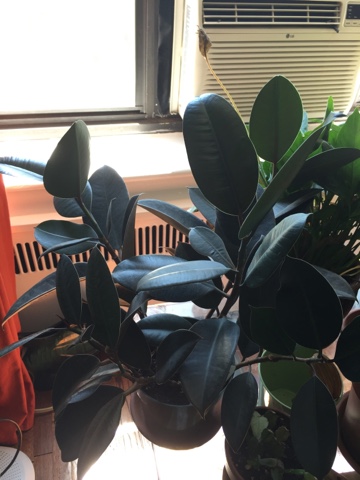
This species of plant is native to Asia, including India, Nepal, Malaysia, Indonesia, Bhutan, Burma, and parts of China. It’s actually not used to make commercial rubber, at least not anymore, although there was a time that the creamy, sticky substance in the leaf was used for that purpose, and the name stuck. The leaves can get pretty big, upwards of 10 inches long and 5 inches wide if you let it.
It’s important to keep the soil of a rubber plant moist–if it becomes dry the plant will interpret this as a dry season approaching and start to shed some of its leaves.On the other hand, you don’t want to water it too much or the leaves will turn yellow. That said, a little overwatering and underwatering are fine, as the plant is very forgiving.
When new leaves grow, it makes for one of the most beautiful plants in the house with its thick, sturdy leaves. This plant rates 9 out of 10 for removing chemicals in the air.
Essential Rubber Plant Care Tips for Healthy Growth
1) Ensure that the plant is in a place where it gets bright indirect light throughout the day. Some direct sunlight in the morning is fine.
2) Water the plant thoroughly and let it dry out partially before you water it again.
3) Wash the leaves from time to time with a clean, wet cloth.
4) Use a well-draining potting soil.
5) Repot every 36 months
Article source: http://www.indoorgardener.org/2015/05/rubber-plant-ficus-robusta-best-air.html
Frequently Asked Questions About Rubber Plants
How effective is the Rubber Plant at purifying indoor air?
The Rubber Plant (Ficus robusta) rates 9 out of 10 for removing chemicals from indoor air, making it one of the top air purifying houseplants available. It is particularly effective at filtering formaldehyde and other volatile organic compounds commonly found in homes and offices.
What is the difference between Ficus robusta and Ficus elastica?
Ficus robusta is a cultivated variety of Ficus elastica that was specifically bred to serve as an ornamental houseplant. The robusta variety features broader, stiffer, and more upright leaves compared to the elastica, which can grow up to 50-100 feet tall in its natural habitat.
How often should I water my Rubber Plant?
Water your Rubber Plant thoroughly and allow the soil to dry out partially before watering again. Keeping the soil consistently moist is important, as dry soil may cause the plant to shed leaves, but overwatering can lead to yellow leaves. The plant is quite forgiving of minor watering inconsistencies.
Where should I place my Rubber Plant for optimal growth?
Place your Rubber Plant in a location that receives bright indirect light throughout the day. Some direct morning sunlight is acceptable, but avoid harsh afternoon sun. This lighting condition mimics the plant’s natural habitat under the canopy of Asian forests.
How big can Rubber Plant leaves grow indoors?
Rubber Plant leaves can grow quite large, reaching upwards of 10 inches long and 5 inches wide when the plant is healthy and well-cared for. The thick, sturdy leaves are one of the most attractive features of this popular houseplant.
Where is the Rubber Plant originally from?
The Rubber Plant is native to Asia, with its natural range spanning India, Nepal, Malaysia, Indonesia, Bhutan, Burma, and parts of China. While it was once used for rubber production, the name is now primarily historical as commercial rubber comes from other sources today.
How often should I repot my Rubber Plant?
Rubber Plants should be repotted every 36 months to ensure healthy root development and continued growth. Use a well-draining potting soil when repotting, and choose a container slightly larger than the current one to give roots room to expand.
📅 Last updated:
SHARE IT SO OTHERS CAN FIND THE BEST GARDENING INFO